
Loading...

Real 2026 Kerala rates, real performance data — no hype.
AI UGC video production means generating creator-style ad videos — a person holding your product, talking to camera, in a kitchen or a shop — using AI models instead of booking a real creator and a shoot. For a Kerala business, it brings the cost of a single ad video down from roughly ₹5,000–₹15,000 to a few hundred rupees, and the turnaround from two weeks to two hours. That's the entire pitch, and it's a real one. What follows is where it works, where it fails badly, and what it should cost you.
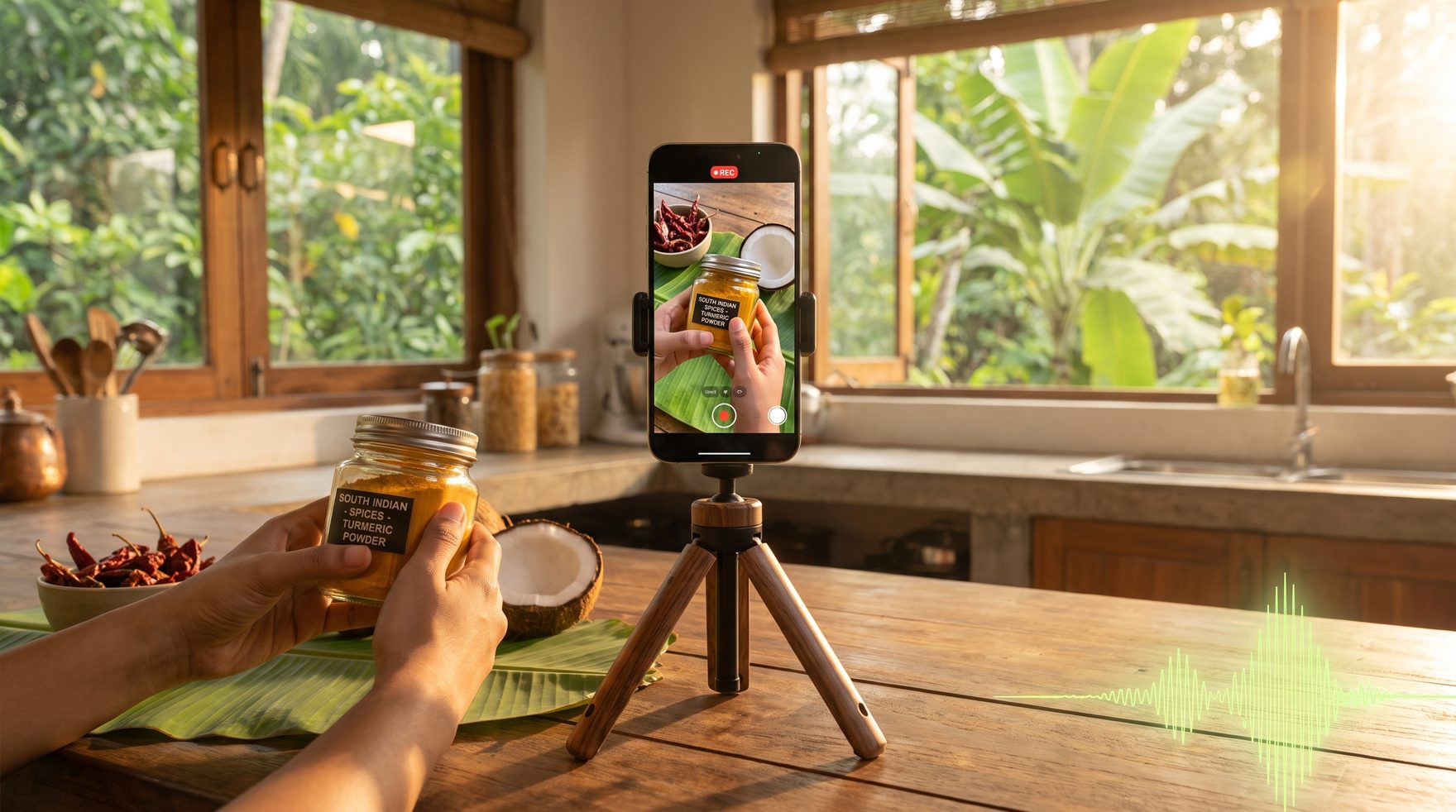
UGC — user-generated content — is the ad format that looks like a customer filmed it on a phone rather than an agency filming it on a rig. Vertical, handheld, unpolished, someone talking straight at the lens. It works because it doesn't look like an advertisement.
AI UGC keeps the format and replaces the production. You supply a product photo and a script; an AI model generates a synthetic presenter delivering the script while the product appears in shot. Nobody was filmed.
| Creator UGC | AI UGC | Studio video | |
|---|---|---|---|
| Cost per video | ₹1,000–₹15,000 (India, 2026) | ₹150–₹800 in tool credits | ₹50,000+ |
| Turnaround | 7–14 days | 1–3 hours | 2–4 weeks |
| Variations of one idea | 1, then repay for more | 20+ from the same brief | 1 |
| Real face customers know? | Yes | No | Yes |
| Films your actual premises? | Yes | No | Yes |
| Best for | Trust and testimonials | Volume and testing | Brand films |
The last two rows decide most Kerala briefs. AI can't film your showroom in Thrissur or your homestay in Wayanad. It can produce forty hook variations for a product you ship across India by Friday.
Three things converged. Meta's ad auction now rewards volume of creative, not perfection of creative — broad targeting with automated placements means the creative is doing most of the targeting work, so more distinct creatives means more chances to find the one that works.
UGC-style creative also fatigues fast. Third-party benchmarks put creative fatigue for UGC-style ads at roughly 10–14 days before a 25–40% performance decline, against 18–25 days for studio creative — which sounds worse for UGC until you note that UGC starts from a much higher baseline. Fast fatigue only hurts if refreshing is expensive. AI makes refreshing cheap.
And the Kerala supply of creators is thin outside Kochi. Directories list dozens of UGC creators around Kochi and very few elsewhere in the state. For a business in Kollam or Kannur, "hire a creator" often means paying for travel, or settling.
For a business spending ₹30,000–₹50,000 a month on Meta ads — which describes most of the Kerala SMEs we work with — the constraint has never been budget. It's been that they have four creatives and have been running them for five months.
Start with the market you're being quoted against. These are 2026 Indian creator UGC rates, per video:
| Format | Entry | Standard | Premium |
|---|---|---|---|
| Fashion / model | ₹1,000–₹2,500 | ₹3,500–₹7,500 | ₹9,500–₹15,000 |
| Unboxing | ₹2,500–₹4,500 | ₹5,500–₹8,500 | ₹10,000–₹15,000 |
| Testimonial | ₹3,500–₹5,500 | ₹6,000–₹10,000 | ₹12,000–₹18,000 |
| Lifestyle / demo | ₹5,000–₹7,500 | ₹8,500–₹12,000 | ₹13,500–₹25,000 |
| How-to / tutorial | ₹6,500–₹9,000 | ₹11,000–₹16,000 | ₹19,000–₹28,000 |
Scripting typically adds ₹1,500–₹3,500 per video, 48-hour rush adds 30–50%, and each extra aspect ratio adds 15–25%.
Now the AI side. The honest number is not "free". Published production logs from teams doing this at volume put a finished AI UGC ad at roughly ₹10,000–₹11,000 in tool credits when you count everything generated and discarded — one team reported generating 108 images and 103 video clips to land 49 usable ones, a hit rate near 50%. A product swap on an existing ad runs closer to ₹2,500. A two-person team producing well gets 4–5 finished ads in a working day.
So AI UGC is not cheaper per attempt. It's cheaper per variation, and dramatically faster. The saving is real but it arrives through volume, not through the first video.
| Package | What you get | Price |
|---|---|---|
| Test Batch | 5 AI UGC videos, 2 hooks each, 1 language, 9:16 | ₹15,000 |
| Monthly Creative Engine | 16 videos/month, 3 languages, all ratios, weekly refresh | ₹35,000/month |
| Hybrid | 2 real creator videos + 12 AI variations built from them | ₹45,000/month |
| Script only | 10 tested ad scripts, you produce | ₹8,000 |
Ad spend is separate. We don't mark up media.
UGC-style creative outperforms studio creative on cold traffic in most consumer categories. Third-party 2026 benchmarks:
| Metric | UGC style | Studio | Category |
|---|---|---|---|
| CTR, cold traffic | 2.4–3.6% | 1.2–1.8% | Across categories |
| ROAS | 2.4–3.0x | 1.6–2.2x | Beauty / skincare |
| ROAS | 2.8–3.2x | 1.9–2.1x | Fitness |
| ROAS, Instagram Reels | 2.8–3.8x | 1.6–2.2x | Reels placement |
| Advantage on Reels/TikTok | +50–80% | baseline | Short-form feeds |
| Advantage on Facebook feed | +15–25% | baseline | Feed placement |
Two caveats worth more than the table. First, these are benchmarks for UGC format, not AI specifically — AI UGC inherits the format advantage only when it's good enough that nobody clocks it as synthetic. When it's not, it underperforms both.
Second, attributed ROAS overstates UGC by roughly 10–20% against incrementality testing. Take a 3.0x attributed return as something nearer 2.5x real. Any agency quoting you attributed ROAS without that caveat is either not measuring or not telling.
Partially, and this is where most of the disappointment lives. AI voice and lip-sync in Malayalam has improved sharply but is still behind English and Hindi. Long sentences drift, and Malayalam-English code-mixing — the way people in Kerala actually speak in ads — is where synthetic delivery most often sounds wrong to a native ear.
What works reliably today:
What doesn't work yet: a two-minute synthetic Malayalam testimonial. It will land in the uncanny valley and cost you trust that's expensive to rebuild.
Good fit:
Poor fit — use real footage instead:
Steps 1, 2, 6 and 7 are where the results come from, and none of them are AI. The tool is the cheapest part of this process. The thinking is not — which is the same argument we make about performance marketing generally.
Two things to keep straight. Meta requires disclosure of realistic AI-generated content and applies labels of its own when it detects it — don't attempt to hide it. ASCI's influencer guidelines require disclosure when a promotion is paid, and its guidance extends to virtual and computer-generated presenters — the principle being that consumers shouldn't be led to believe a real person is vouching for something when none is.
Practically, for a Kerala business: a synthetic presenter demonstrating your product is ordinary advertising. A synthetic presenter saying "I've used this for six months and my skin cleared up" is a fabricated testimonial, and that's a problem regardless of what any guideline says this quarter. The line is testimony, not technology.
Quick answers to common questions on this topic.
If your ads have stopped working, it's usually the creative, not the targeting. Talk to us about a test batch before you commit to a monthly engine.

 Home